Most of us know that planet Earth is situated in the Solar System, which lies in a galaxy called Milky Way. We also know that there are a lot of stars, planets, black holes and other galaxies up there. Before I start writing about them, I'd like to focus on the components of the Universe.
In the past, people thought that the Universe consists only of atoms - molecules made of protons, neutrons and electrons. We can't see atoms because of their incredibly small measures.
We've reached the era of scientists, researchers and a great technology. Nowadays astronomers are able to tell that the Universe is made of three types of substance: normal matter (atoms, also known as baryonic matter), Dark Matter and Dark Energy.
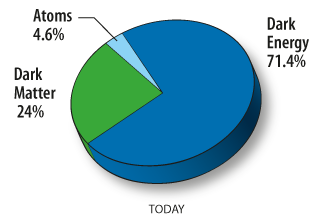
Dark Matter is around 24 or 26 percent of the energy budget in the Universe. Dark Matter is (probably) made of sub-atomic particles. They can be even smaller than atoms! Normal matter and Dark Matter practically don't interact with each other. It is believed, though, that Dark Matter interacts with gravity, it is said to pull. Dark Matter is still a big mystery, researchers don't know much about it yet.
When it comes to Dark Energy, which is around 71.4 percent of the Universe's energy budget, it's something completely different from Dark Matter or normal matter. Scientists got to know that it actually exists in 1990. Back then, they noticed that the Universe's expansion is speeding up all the time. That had to be caused by something they called Dark Energy. Dark Energy is something that pushes out on the fabric in space-time. Astronomers don't know what is the form of Dark Energy but they can see its effects.
Normal matter, on the other hand, is like 4.6 percent of the Universe's energy budget.
Here is a circle diagrame that illustrates the percentage of the Universe's energy budget:
I think these components are sort of unimaginable for humans but I find this topic very interesting. If you'd like to know more about it, you can look at the websites I was using when writing this post.
Sources: https://map.gsfc.nasa.gov/universe/uni_matter.html
http://www.physicsmatt.com/dark-matter/
