poniedziałek, 13 listopada 2017

Cosmic Microwave Background Radiation - a leftover from The Big Bang

                                Have you ever seen black and grey dots on a TV screen after changing to an empty channel? Have you heard that strange noise when there was static? If yes, you've partly seen and heard Cosmic Microwave Background Radiation that occurs in the Universe. How's it possible?
                                CMB (Cosmic Microwave Background) is known to be a radio emission which is the result of the earliest stage of the Universe's evolution: The Big Bang. Even though we can't see it, the radiation reaches us from all directions. What's more: the existence of CMB was predicted by an American cosmologist Ralph Apher in 1948 but nobody really believed it would turn out to be true. There was a huge breakthrough in 1965 when two researchers Arno Penzias and Robert Wilson found out that actually there is a radiation coming from the sky. The interesting thing is that they did it by accident while they were working on a radio receiver. Wait, but where in the world did that emission come from?
                                As I wrote in my previous post - The Universe's temperature was really high in the past. When it cooled down enough, around 400,000 years after The Big Bang, there were better conditions for atoms to form, though they were still really hot. Hot matter emits particles called photons. Photons separated from the first atoms' electrons and filled the whole Universe. These photons cause the radiation I'm writing about. It's fascinating that they still exist, isn't it?
                                This is the picture of the CMB taken by one of the European Space Agency's satellites in 2013:


                                 You can get to know more by reading the article and watching the video:
https://www.space.com/33892-cosmic-microwave-background.html
https://www.youtube.com/watch?v=1kqWWLpyMpY

niedziela, 12 listopada 2017

The Big Bang theory - the beginning of space and time

                  The Universe has its own complexities that most astronomers managed to understand. They even proved them, although they still don't know how exactly the Universe began. In this post I'm going to focus on a theory called The Big Bang which is, in my opinion, the most likely.
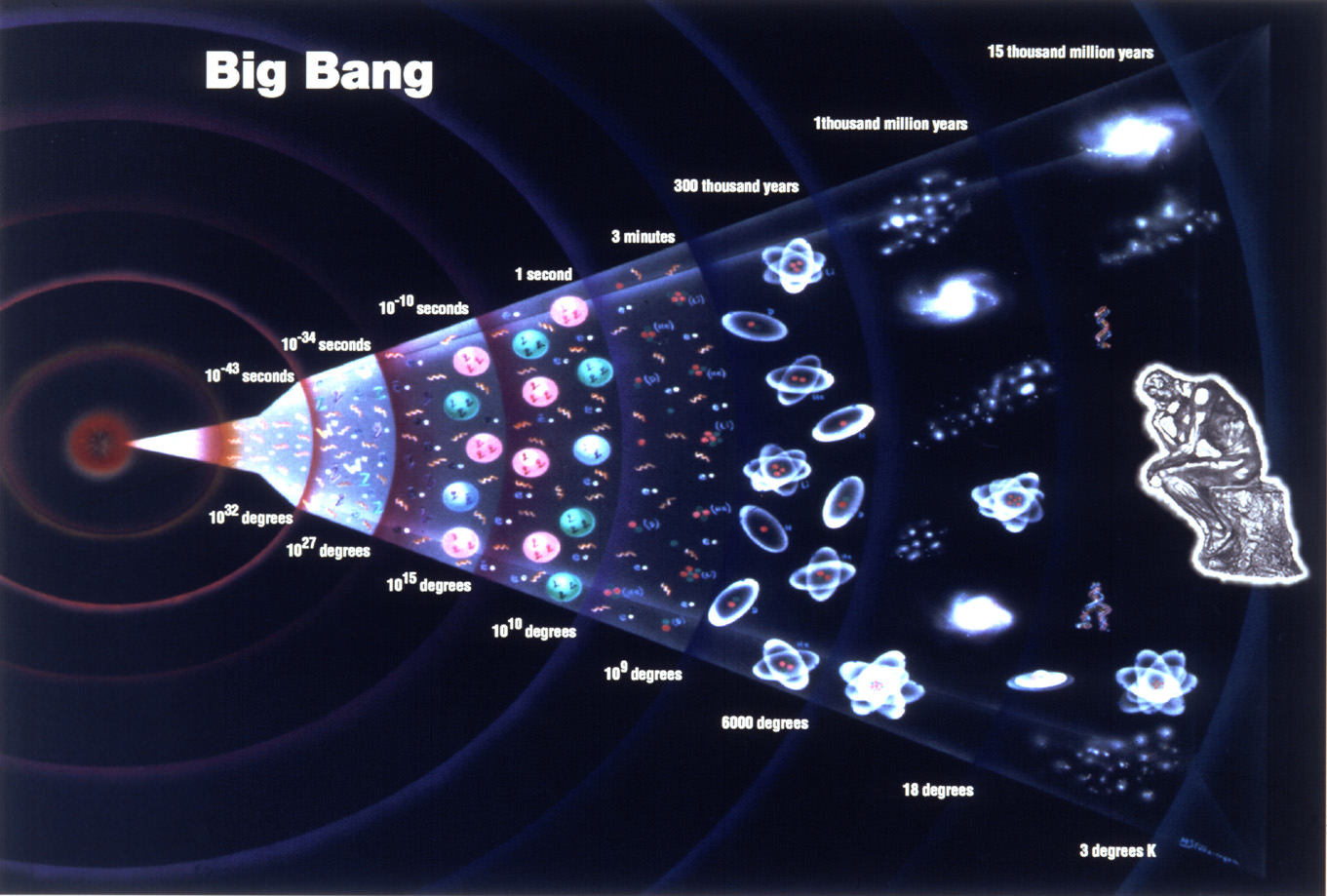
                   The Big Bang took place a very long time ago, that means around 13.8 billion years. Back then, space and time didn't exist. There was just a tiny point of infinite density which consisted of all the future matter and forces of the Universe. Astronomers use to call it "Singularity". The temperature in that point was incredibly high.
                   Afterwards, Singularity started to expand really fast. Time and space were born. It all happened in a fraction of a second. During the expansion the temperature and density became lower. Small elementary particles started to form. Finally baryonic matter came into existence. It's the matter that we know today - made of protons, neutrons and electrons.
                    Several billion years later atoms began to get closer to each other with the help of gravity. These particles formed planets, stars and galaxies.
                    I'm sure you've heard about The Big Bang before but you probably think it's just a speculation. However, there is evidence for that theory, such as the fact that the Universe is expanding (galaxies are moving away from each other), so there must've been a time when everything was situated in a single point. Another instance of proof that The Big Bang really took place is the existence of Cosmic Microwave Background Radiation which I'm going to write about in the next post.
                     I summarized everything that I've read but if you want to know more, you can look at the source: https://www.universetoday.com/54756/what-is-the-big-bang-theory/
                 Illustration of the Big Bang Theory